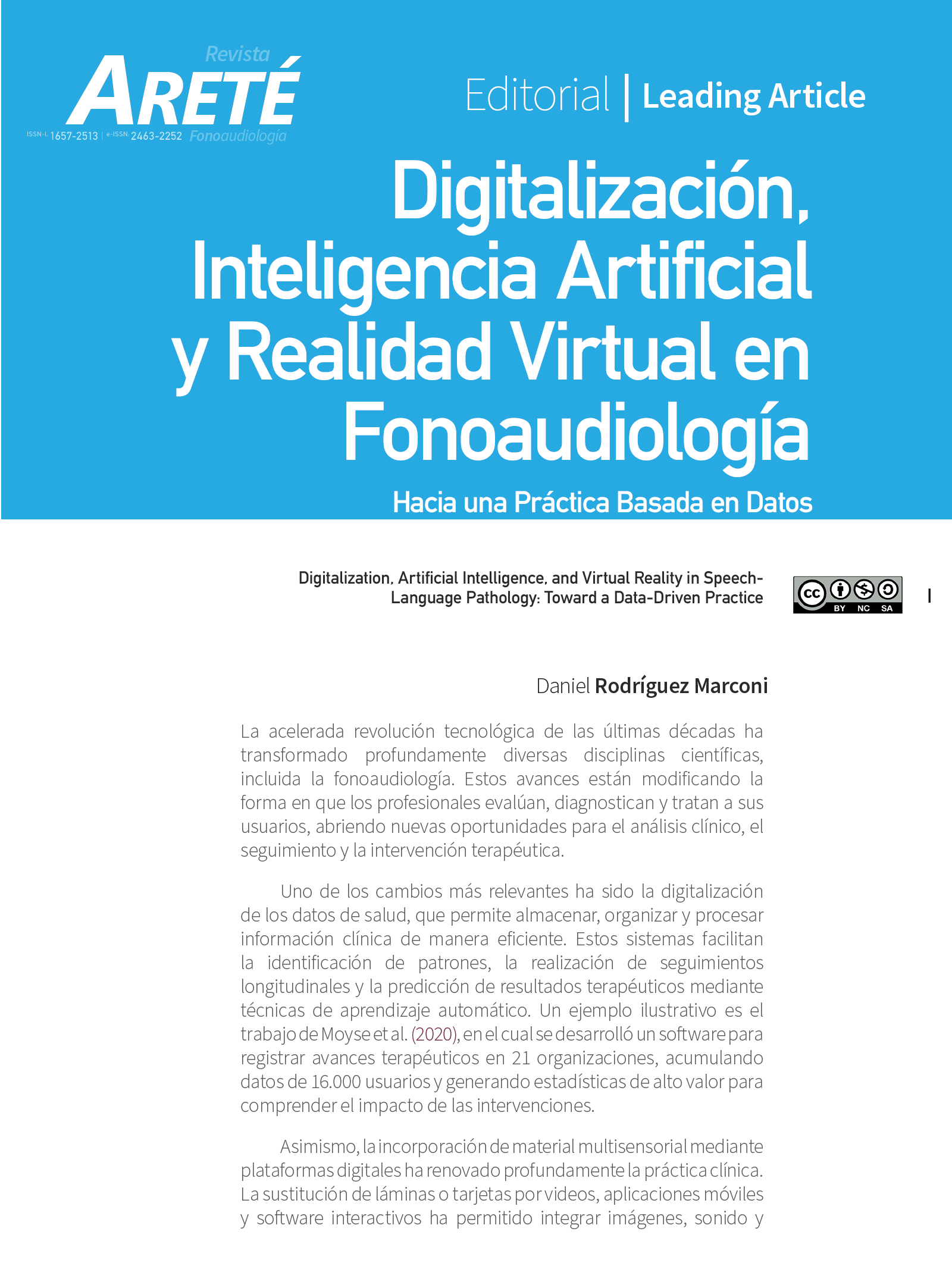
Digitalization, Artificial Intelligence, and Virtual Reality in Speech-Language Pathology: Toward a Data-Driven Practice
Digitalización, Inteligencia Artificial y Realidad Virtual en Fonoaudiología: Hacia una Práctica Basada en Datos
Article Sidebar
 PDF (Español (España))
 FLIP
FLIP
 XML (Español (España))
Authors who publish in Revista Areté agree to the following terms:
1. Authors retain the copyright of their works and grant the journal the right of first publication.
The content is published under a Creative Commons Attribution-NonCommercial-ShareAlike 4.0 International (CC BY-NC-SA 4.0) license, which allows others to use, share, and adapt the published material, provided that proper credit is given to the author(s) and the original publication in this journal, the material is not used for commercial purposes, and any derivative works are distributed under the same license.
2. Authors acknowledge and accept the journal’s Open Access Policy, which ensures free and unrestricted access to all published content, with no charges for readers or publication fees for authors.
3. The views and opinions expressed in the articles are the sole responsibility of the authors and do not necessarily reflect those of Revista Areté or the Corporación Universitaria Iberoamericana.
4. The contents of Revista Areté are available online in full, free of charge and without the need for registration.
Criterio Libre Jurídico is distributed under a Creative Commons License.

Creative Commons Attribution-NonComercial-ShareAlike 4.0 International
Main Article Content
The editorial describes how the technological revolution has transformed speech-language pathology, reshaping evaluation, diagnosis, and clinical intervention. The digitalization of health data now allows the storage of large datasets, the identification of patterns, and the prediction of therapeutic outcomes through machine learning. At the same time, digital platforms with multisensory materials and a growing range of specialized applications are renewing traditional practices.
Digital resources have also strengthened home-based work, improving treatment adherence and the understanding of therapeutic instructions, while digital games offer more intensive training. Telepractice, consolidated during the pandemic, proved effective and expanded access to services, supported by an increasing body of evidence.
New monitoring tools—such as wearable sensors, vocal dosimeters, and devices that record communicative behavior—provide objective measurements in real-life contexts. Virtual reality creates opportunities to train communication skills in simulated yet ecologically valid environments. Artificial intelligence and the Internet of Things are emerging as powerful areas of innovation, from conversational agents to complex monitoring systems.
Despite these advances, there is a gap between technological innovation and its incorporation into academic training and clinical practice. The field must critically integrate these tools, update teaching models, and adopt data-driven, evidence-based approaches to strengthen therapeutic effectiveness and broaden the scope of speech-language pathology.
Downloads
Article Details
Bottalico, P., & Nudelman, C. J. (2023). Do-it-yourself voice dosimeter device: A tutorial and performance results. Journal of Speech, Language, and Hearing Research, 66(7), 2149-2163.
Deka, C., Shrivastava, A., Abraham, A. K., Nautiyal, S., & Chauhan, P. (2025). AI-based automated speech therapy tools for persons with speech sound disorder: A systematic literature review. Speech, Language and Hearing, 28(1), 2359274.
Ding, H., Simmich, J., Vaezipour, A., Andrews, N., & Russell, T. (2024). Evaluation framework for conversational agents with artificial intelligence in health interventions: A systematic scoping review. Journal of the American Medical Informatics Association, 31(3), 746-761.
Guglani, I., Sanskriti, S., Joshi, S. H., & Anjankar, A. (2023). Speech-language therapy through telepractice during COVID-19 and its way forward: A scoping review. Cureus, 15(9).
Lekova, A., Andreeva, A., Tanev, T., Simonska, M., & Kostova, S. (2022). A system for speech and language therapy with a potential to work in the IoT. 119-124.
Moyse, K., Enderby, P., Chadd, K., Gadhok, K., Bedwell, M., & Guest, P. (2020). Outcome measurement in speech and language therapy: A digital journey. BMJ Health & Care Informatics, 27(1), e100085.
Munsell, M., De Oliveira, E., Saxena, S., Godlove, J., & Kiran, S. (2020). Closing the digital divide in speech, language, and cognitive therapy: Cohort study of the factors associated with technology usage for rehabilitation. Journal of Medical Internet Research, 22(2), e16286.
Remacle, A., Bouchard, S., & Morsomme, D. (2023). Can teaching simulations in a virtual classroom help trainee teachers to develop oral communication skills and self-efficacy? A randomized controlled trial. Computers and Education, 200, 104808. https://doi.org/10.1016/j.compedu.2023.104808
Saeedi, S., Bouraghi, H., Seifpanahi, M.-S., & Ghazisaeedi, M. (2022). Application of digital games for speech therapy in children: A systematic review of features and challenges. Journal of healthcare engineering, 2022(1), 4814945.
Santos, J., Vairinhos, M., Rodriguez, J., & Jesus, L. M. (2022). Home-based activities for children with speech sound disorders: Requirements for a tangible user interface for internet of things artefacts. Applied Sciences, 12(18), 8971.
Teti, S. D., Murray, L. L., Orange, J., Kankam, K. S., & Roberts, A. C. (2025). Telepractice Assessments for Individuals with Aphasia: A Systematic Review. Telemedicine and e-Health, 31(1), 37-49.
Vaezipour, A., Campbell, J., Theodoros, D., & Russell, T. (2020). Mobile apps for speech-language therapy in adults with communication disorders: Review of content and quality. JMIR mHealth and uHealth, 8(10), e18858.