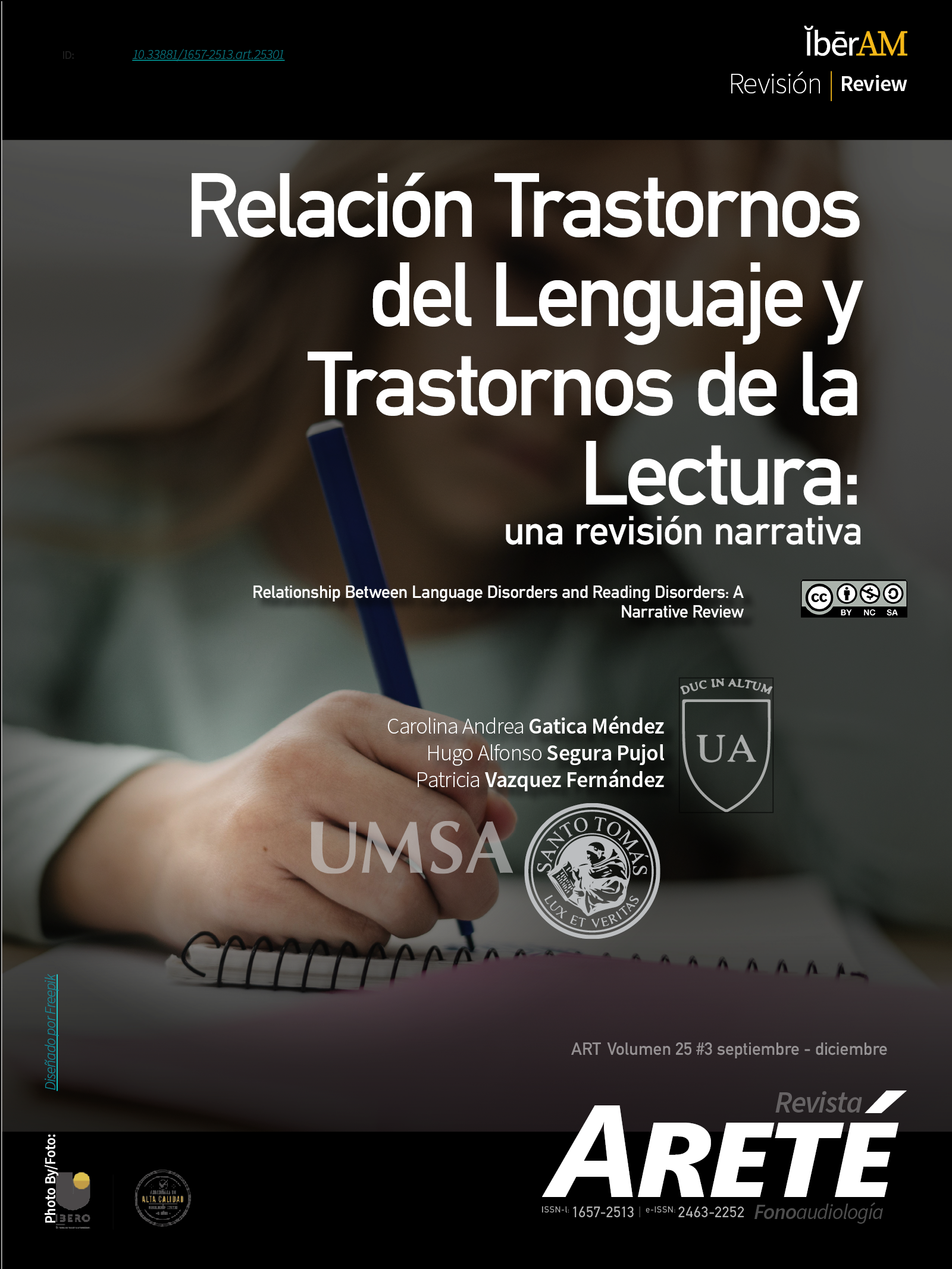
Relationship Between Language Disorders and Reading Disorders: A Narrative Review
Relación Trastornos del Lenguaje y Trastornos de la Lectura: una revisión narrativa
Article Sidebar
 pdf (Español (España))
 FLIP
FLIP
 XML (Español (España))

Authors who publish in Revista Areté agree to the following terms:
1. Authors retain the copyright of their works and grant the journal the right of first publication.
The content is published under a Creative Commons Attribution-NonCommercial-ShareAlike 4.0 International (CC BY-NC-SA 4.0) license, which allows others to use, share, and adapt the published material, provided that proper credit is given to the author(s) and the original publication in this journal, the material is not used for commercial purposes, and any derivative works are distributed under the same license.
2. Authors acknowledge and accept the journal’s Open Access Policy, which ensures free and unrestricted access to all published content, with no charges for readers or publication fees for authors.
3. The views and opinions expressed in the articles are the sole responsibility of the authors and do not necessarily reflect those of Revista Areté or the Corporación Universitaria Iberoamericana.
4. The contents of Revista Areté are available online in full, free of charge and without the need for registration.
Criterio Libre Jurídico is distributed under a Creative Commons License.

Creative Commons Attribution-NonComercial-ShareAlike 4.0 International
Citations


Main Article Content

Language and communication are fundamental processes in human learning and development; among these, reading serves as a means to access knowledge and learn from it. However, many children present or have presented Language Disorders, Reading Disorders, or both concurrently. This review aims to answer the question: What is the relationship between Language Disorders and Reading Difficulties? The underlying issue is the concern regarding significant difficulties in reading comprehension, considering that a large number of children worldwide are failing to acquire basic reading skills and general learning abilities. A search was conducted in different databases (WOS, SCOPUS, EBSCO), and the selected articles were reviewed, analyzed, and discussed throughout this work. The findings suggest that deficiencies in vocabulary skills, morphosyntax, and phonological awareness influence reading fluency, as well as the interpretation of meanings. Furthermore, it is described how dyslexia, characterized by phonologically based problems, can occur simultaneously with a language disorder, further intensifying comprehension difficulties. It is concluded that there is a relationship between Language Disorders and reading problems, as well as the importance of early oral language skill development for the subsequent acquisition of reading.







Downloads
Article Details
Acha, J. (2016). Hacia un modelo multidimensional del trastorno específico del lenguaje y la dislexia: Déficits compartidos y específicos. 2, 107–141. https://doi.org/10.5209/rlog.58545
Adlof, S., Baron, L., Bell, B., & Scoggins, J. (2021). Spoken Word Learning in Children With Developmental Language Disorder or Dyslexia. Journal of Speech, Language, and Hearing Research, 64, 2734–2749. https://doi.org/https://doi.org/10.1044/2021_JSLHR-20-00217
Agencia de la Calidad de la Educación. (2022). Informe Nacional PISA 2022 Evaluación internacional de estudiantes tras la pandemia.
American Psychiatric Association. (2014). Guía de consulta de los criterios diagnósticos del DSM-5 (Inc. , C. Burg Translations, Trans.). www.appi.org
Apel, K. (2022). A Different View on the Simple View of Reading. Remedial and Special Education, 43(6), 434–447. https://doi.org/10.1177/07419325211063487
Bascuñan Vidal, J., Carreño Dittus, M., Collao Pinto, I., Hernández Zavala, P., & De Barbieri Ortiz, Z. (2021). Comparative study of linguistic and reading skills between a group of children with specific language impairment and a group of children with dyslexia. Onomazein, 53, 154–175. DOI:10.7764/onomazein.53.08
Benton, A. L. (1964). Developmental Aphasia and Brain Damage. Cortex, 1(1), 40–52. https://doi.org/10.1016/S0010-9452(64)80012-5
Bishop, D. (2017). Why is it so hard to reach agreement on terminology? The case of developmental language disorder (DLD). International Journal of Language and Communication Disorders, 52(6), 671–680. https://doi.org/10.1111/1460-6984.12335
Broc, L., Joye, N., Dockrell, J., & Olive, T. (2021). Capturing the nature of the spelling errors in DLD: A scoping review 1 1 Capturing the nature of the spelling errors in Developmental Language Disorder: A 2 scoping review 3 4 Lucie Broc. Language, Speech, and Hearing Services in Schools, 52, 1127–1140. https://doi.org/10.1044/2021_LSHSS-20-00086
Buil-Legaz, L., Aguilar-Mediavilla, E., & Rodríguez-Ferreiro, J. (2016). Oral morphosyntactic competence as a predictor of reading comprehension in children with specific language impairment. International Journal of Language & Communication Disorders, 51(4), 473–477. https://doi.org/10.1111/1460-6984.12217
Calero, A., & Calero-Pérez, E. (2021). Orthographic depth and reading comprehension in Spanish. OCNOS, 20(2), 33–42. https://doi.org/10.18239/OCNOS_2021.20.2.2274
Camarillo Salazar, B., Silva Maceda, G., & Romero Contreras, S. (2021). The Simple View of Reading in the identification of reading difficulties in primary education. Estudios Pedagogicos, 47(3), 343–357. https://doi.org/10.4067/S0718-07052021000300343
Capin, S., Gillam, A., Fall, A., Roberts, G., Dille, J. & Gillam, R. (2022). Understanding the nature and severity of reading difficulties among students with language and reading comprehension difficulties. Annals of Dyslexia, 72(2), 249–275. https://doi.org/10.1007/s11881-022-00255-3
Carreño-Sepúlveda, F., & Arancibia-Gutiérrez, B. (2024). Phonological Awareness and Reading Fluency in Children with and without Developmental Language Disorder in Second, Third, and Fourth Grade of Primary School. Revista Chilena de Fonoaudiologia, 23. https://doi.org/10.5354/0719-4692.2024.66839
CIE - 11. (2022). Clasificación Internacional de Enfermedades Undécima Revisión.
Cubilla-Bonnetier, D. (2024). Prevalencia de Dislexia del desarrollo en español: Un metaanálisis. Revista Argentina de Ciencias Del Comportamiento, 16, 1–13.
DeLuca, T., Radville, K. M., Pfeiffer, D. L., & Hogan, T. (2025). Defining Developmental Language Disorder and Dyslexia in Schools: A Mixed-Methods Analysis. Journal of Speech, Language, and Hearing Research : JSLHR, 68(2), 618–635. https://doi.org/10.1044/2024_JSLHR-24-00202
Earle, F. S., & Del Tufo, S. N. (2021). Literacy-supporting skills in college students with specific reading comprehension deficit and developmental language disorder. Annals of Dyslexia, 71(2), 282–298. https://doi.org/10.1007/s11881-020-00211-z
Garcia Madruga, J. A., Elosúa, M. rosa., Gutierrez, Francisco., Luque, J. L., & Garate, Milagros. (2004). Comprensión lectora y memoria operativa / Reading Comprehension and Working Memory (Spanish Edition). https://www.amazon.com/-/es/Comprension-lectora-memoria-operativa-Comprehension/dp/8449316871/ref=monarch_sidesheet_title
Gough, P. B., & Tunmer, W. E. (1986). Decoding, Reading, and Reading Disability. Remedial and Special Education, 7, 6–10. https://doi.org/10.1177/074193258600700104
Gough, S. M., Palikara, O., & Lucas, R. M. (2018). Explaining Reading Comprehension in Children with Developmental Language Disorder: The Importance of Elaborative Inferencing. Journal of Speech, Language, and Hearing Research, 61, 1–43. https://doi.org/10.1044/2018_JSLHR-L-17-0416
Hoover, W., & Gough, P. (1990). The simple view of reading. Reading and Writing, 2, 127–160. https://doi.org/10.1007/BF00401799
Hulme, C., & Snowling, M. J. (2014). The interface between spoken and written language: Developmental disorders. In Philosophical Transactions of the Royal Society B: Biological Sciences (Vol. 369, Issue 1634). Royal Society. https://doi.org/10.1098/rstb.2012.0395
Lara-Díaz, M. F., Mateus-Moreno, A., & Beltrán-Rojas, J. C. (2021). Reading and Oral Language Skills in Children With Developmental Language Disorder: Influence of Socioeconomic, Educational, and Family Variables. Frontiers in Psychology, 12, 1–9. https://doi.org/10.3389/fpsyg.2021.718988
Launay, C., & Maissonny, S. B. (1986). Trastornos del lenguaje, la palabra y la voz en el niño. Trastornos Del Lenguaje, La Palabra y La Voz En El Niño, 281–282. https://dialnet.unirioja.es/servlet/libro?codigo=10080
Leonard, L. B. (1981). An Invited Article Facilitating linguistic skills in children with specific language impairment. Applied Psycholinguistics, 2(2), 89–118. https://doi.org/10.1017/S0142716400000886
Leonard, L. B. (2020). A 200-Year History of the Study of Childhood Language Disorders of Unknown Origin: Changes in Terminology. Perspectives of the ASHA Special Interest Groups, 5(1), 6–11. https://doi.org/10.1044/2019_pers-sig1-2019-0007
Malins, J. G., Landi, N., Ryherd, K., Frijters, J. C., Magnuson, J. S., Rueckl, J. G., Pugh, K. R., Sevcik, R., & Morris, R. (2021). Is that a pibu or a pibo? Children with reading and language deficits show difficulties in learning and overnight consolidation of phonologically similar pseudowords. Developmental Science, 24(2). https://doi.org/10.1111/desc.13023
Mariangel, S. V., & Riffo, B. E. (2020). Papel de la conciencia sintáctica en la comprensión lectora de estudiantes chilenos de 2° a 8° grado de educación primaria. 41, 17–31.
Martins, L. Z., & Cárnio, M. S. (2020). Reading comprehension in dyslexic schoolchildren after an intervention program. CODAS, 32(1), 1–8. https://doi.org/10.1590/2317-1782/20192018156
Mendoza Lara, E. (2016). Trastorno específico del lenguaje (TEL). https://www.edicionespiramide.es/libro/psicologia/trastorno-especifico-del-lenguaje-tel-elvira-mendoza-lara-9788436836196/
Meneses, A., Uccelli, P., Santelices, M. V., Ruiz, M., Acevedo, D., & Figueroa, J. (2018). Academic Language as a Predictor of Reading Comprehension in Monolingual Spanish-Speaking Readers: Evidence From Chilean Early Adolescents. Reading Research Quarterly, 53(2), 223–247. https://doi.org/10.1002/rrq.192
Mulas, F., Etchepareborda, M., Díaz-Lucero, A., & Ruiz-Andrés, R. (2006). [Language and neurodevelopmental disorders. A review of their clinical characteristics]. Revista de Neurología, 42, 103–109. https://www.researchgate.net/publication/7224389
Nation, K. (2019). Children’s reading difficulties, language, and reflections on the simple view of reading. Australian Journal of Learning Difficulties, 24(1), 47–73. https://doi.org/10.1080/19404158.2019.1609272
Nippold, M. A. (2017). Reading comprehension deficits in adolescents: Addressing underlying language abilities. Language, Speech, and Hearing Services in Schools, 48(2), 125–131. https://doi.org/10.1044/2016_LSHSS-16-0048
Norambuena, Y. S., Sáez, K. L., Fuentes, D., Ponce, F. P., & Salas, G. (2022). Language, analogical reasoning, and working memory skills in emergent literacy period: Typical and DLD trajectories via Cluster Analyses. Early Childhood Research Quarterly, 60, 173–186. https://doi.org/10.1016/j.ecresq.2022.01.005
Owens, R. (2012). Language Development an introduction (Pearson Education, Ed.; 8th ed.). Pearson.
Pratt, A. S., Grinstead, J. A., & McCauley, R. J. (2020a). Emergent literacy in spanish-speaking children with developmental language disorder: Preliminary findings of delays in comprehension-and code-related skills. Journal of Speech, Language, and Hearing Research, 63(12), 4193–4207. https://doi.org/10.1044/2020_JSLHR-19-00239
Pratt, A. S., Grinstead, J. A., & McCauley, R. J. (2020b). Emergent literacy in spanish-speaking children with developmental language disorder: Preliminary findings of delays in comprehension-and code-related skills. Journal of Speech, Language, and Hearing Research, 63(12), 4193–4207. https://doi.org/10.1044/2020_JSLHR-19-00239
Ramírez Santana, G., Acosta Rodríguez, V., Hernández Expósito, S., & Delgado Cruz, A. (2023). Intervention in Early Reading among Pupils with Developmental Language Disorder. Revista Signos, 56(112), 306–324. https://doi.org/10.4067/S0718-09342023000200306
Rebolledo Luna, V., Farías, K., Figueroa Sandoval, M., San Martín Alarcón, V., & Sbarbaro, R. (2024). Características del Trastorno del Desarrollo del Lenguaje en lectura y escritura en primer ciclo básico. Revista Reflexión e Investigación Educacional, 6, 1–13.
Reyes, M. A., & De Barbieri, Z. (2018). Habilidades lingüísticas y decodificación en niños con Trastorno Específico del Lenguaje con y sin dificultades de comprensión lectora. Revista Chilena de Fonoaudiología, 17, 1–11. https://doi.org/10.5354/0719-4692.2018.51641
Ripoll Salceda, J. C. (2023). Reading in Spanish-speaking students with developmental language disorder. A review. Revista de Logopedia, Foniatria y Audiologia, 43(2), 1–10. https://doi.org/10.1016/j.rlfa.2022.04.004
Salguero Santana, M., Álvarez Arrieta, Y., Verane Dubalón, D., & Santelices Jiménez, Y. (2016). “El desarrollo del lenguaje. Detección precoz de los retrasos/trastornos en la adquisición del lenguaje.” Revista Cubana de Tecnología de la Salud, 43–57. SSN: 2218-6 719 RNPS: 2252
Sansavini, A., Favilla, M. E., Guasti, M. T., Marini, A., Millepiedi, S., Di Martino, M. V., Vecchi, S., Battajon, N., Bertolo, L., Capirci, O., Carretti, B., Colatei, M. P., Frioni, C., Marotta, L., Massa, S., Michelazzo, L., Pecini, C., Piazzalunga, S., Pieretti, M., … Lorusso, M. L. (2021). Developmental language disorder: Early predictors, age for the diagnosis, and diagnostic tools. A scoping review. Brain Sciences, 11(5). https://doi.org/10.3390/brainsci11050654
Snowling, M. J., Hayiou-Thomas, M. E., Nash, H. M., & Hulme, C. (2020). Dyslexia and Developmental Language Disorder: comorbid disorders with distinct effects on reading comprehension. Journal of Child Psychology and Psychiatry and Allied Disciplines, 61(6), 672–680. https://doi.org/10.1111/jcpp.13140
Stone, R., de Hoop, T., Coombes, A., & Nakamura, P. (2020). What works to improve early grade literacy in Latin America and the Caribbean? A systematic review and meta-analysis. Campbell Systematic Reviews, 16(1). https://doi.org/10.1002/cl2.1067
Tamayo Lorenzo, S. (2017). La Dislexia y las Dificultades en la adquisición de la lectoescritura. Revista de Curriculum y Formación Del Profesorado, 21, 423–432. https://doi.org/10.30827/profesorado.v21i1.10372
Unesco. (2022). Informe de seguimiento de la educación en el mundo. Informe sobre género: profundizar en el debate sobre quienes todavía están rezagados. Informe de Seguimiento de La Educación En El Mundo. Informe Sobre Género: Profundizar En El Debate Sobre Quienes Todavía Están Rezagados. https://doi.org/10.54676/LHMC7003
Van Dijk, T. A., & Kintsch, W. (1982). Strategies of Discourse Comprehension (Academic Press).
Van Viersen, S., de Bree, E. H., Zee, M., Maassen, B., van der Leij, A., & de Jong, P. F. (2018). Pathways Into Literacy: The Role of Early Oral Language Abilities and Family Risk for Dyslexia. Psychological Science, 29(3), 418–428. https://doi.org/10.1177/0956797617736886
Werfel, K. L., & Krimm, H. (2017). A preliminary comparison of reading subtypes in a clinical sample of children with specific language impairment. Journal of Speech, Language, and Hearing Research, 60(9), 2680–2686. https://doi.org/10.1044/2017_JSLHR-L-17-0059
Wong, S. W. L., Li, W. O., & Cheung, A. (2023). Graphic novel reading comprehension in Chinese children with developmental language disorder (DLD). Reading and Writing, 36(7), 1631–1649. https://doi.org/10.1007/s11145-022-10346-7