Speech-language pathology as a life choice: reflection on professional vocation
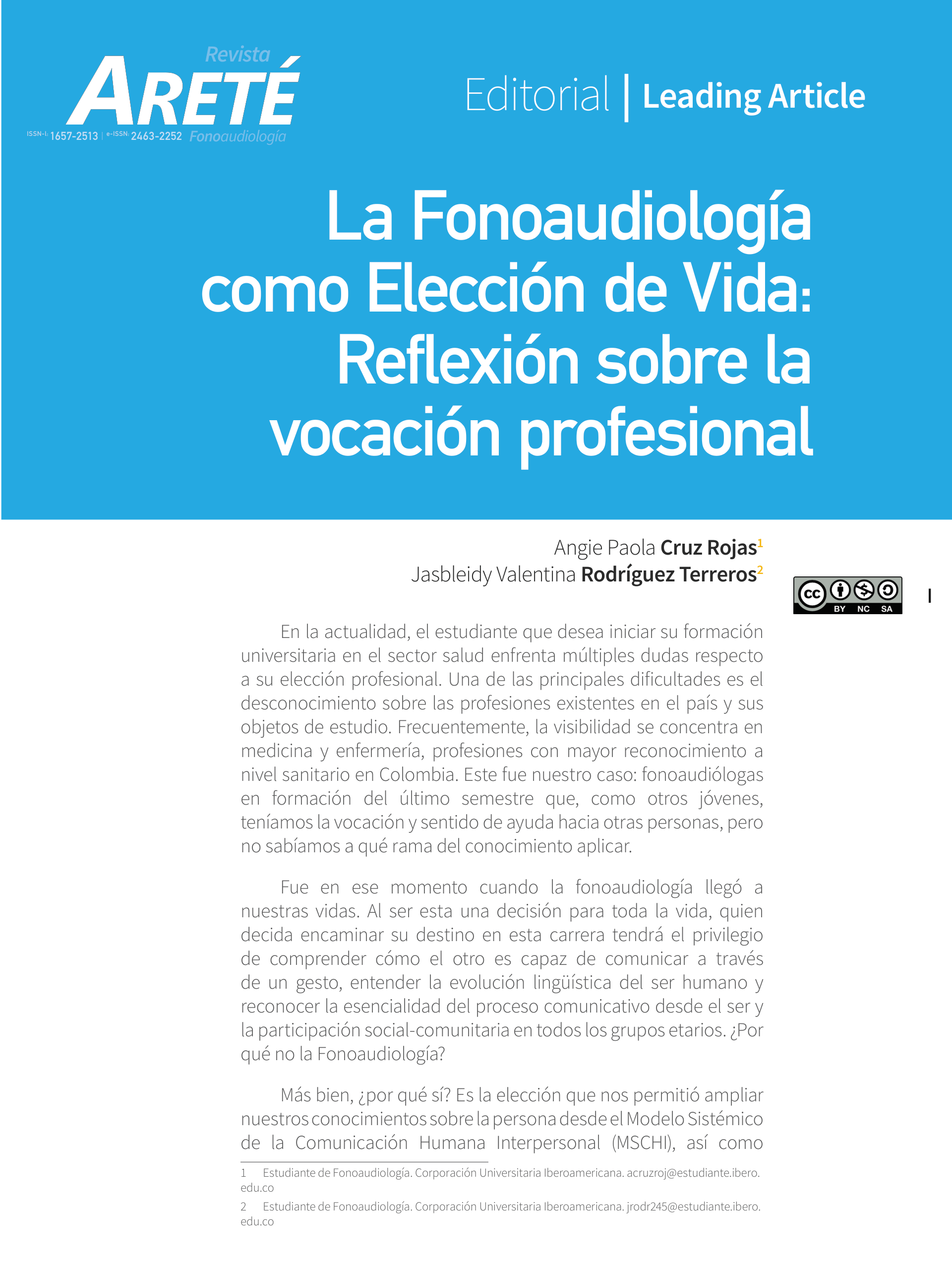
La fonoaudiología como elección de vida: reflexión sobre la vocación profesional
Article Sidebar
 PDF (Español (España))
 FLIP

Authors who publish in Revista Areté agree to the following terms:
1. Authors retain the copyright of their works and grant the journal the right of first publication.
The content is published under a Creative Commons Attribution-NonCommercial-ShareAlike 4.0 International (CC BY-NC-SA 4.0) license, which allows others to use, share, and adapt the published material, provided that proper credit is given to the author(s) and the original publication in this journal, the material is not used for commercial purposes, and any derivative works are distributed under the same license.
2. Authors acknowledge and accept the journal’s Open Access Policy, which ensures free and unrestricted access to all published content, with no charges for readers or publication fees for authors.
3. The views and opinions expressed in the articles are the sole responsibility of the authors and do not necessarily reflect those of Revista Areté or the Corporación Universitaria Iberoamericana.
4. The contents of Revista Areté are available online in full, free of charge and without the need for registration.
Criterio Libre Jurídico is distributed under a Creative Commons License.

Creative Commons Attribution-NonComercial-ShareAlike 4.0 International
Citations


Main Article Content


In this editorial, the experience lived during training as speech-language pathology students in the final semester at Corporación Universitaria Iberoamericana is shared, reflecting on the process of professional choice and vocational journey.
The initial doubts faced regarding career choice in the health sector are presented, evidencing the widespread lack of knowledge about professions beyond medicine and nursing. Speech-language pathology is configured as a transformative decision that allowed for understanding human communication from multiple dimensions: intrapersonal, interpersonal, and sociocultural. Through training in the Systemic Model of Interpersonal Human Communication (MSCHI) and participation in the Research Group on Deaf Studies, a profound understanding of communicative diversity and inclusion was developed.
It is emphasized how speech-language pathology is configured as a profession that allows connection with others from empathy, making it possible to make a positive impact in vulnerable communities such as the deaf and deafblind population.
Finally, young people with doubts about their professional training are invited to consult Revista Areté, where innovative approaches and research can be found that illustrate the multiple areas of speech-language pathology practice from the perspective of communicative diversity and inclusion.